English
 русский
 Español
Contenido
- 1 What Is an All Stainless-Steel Air Shower Room?
- 2 Why Material Choice Directly Affects Cleaning Performance
- 3 Core Components and How They Work Together
- 4 Matching Air Shower Specifications to Your Cleaning Goals
- 5 Personnel vs. Cargo Air Showers: Different Configurations for Different Goals
- 6 Operational Best Practices to Maximize Decontamination Effectiveness
- 7 Integration with Broader Contamination Control Strategy
- 8 Total Cost of Ownership and Long-Term Value
What Is an All Stainless-Steel Air Shower Room?
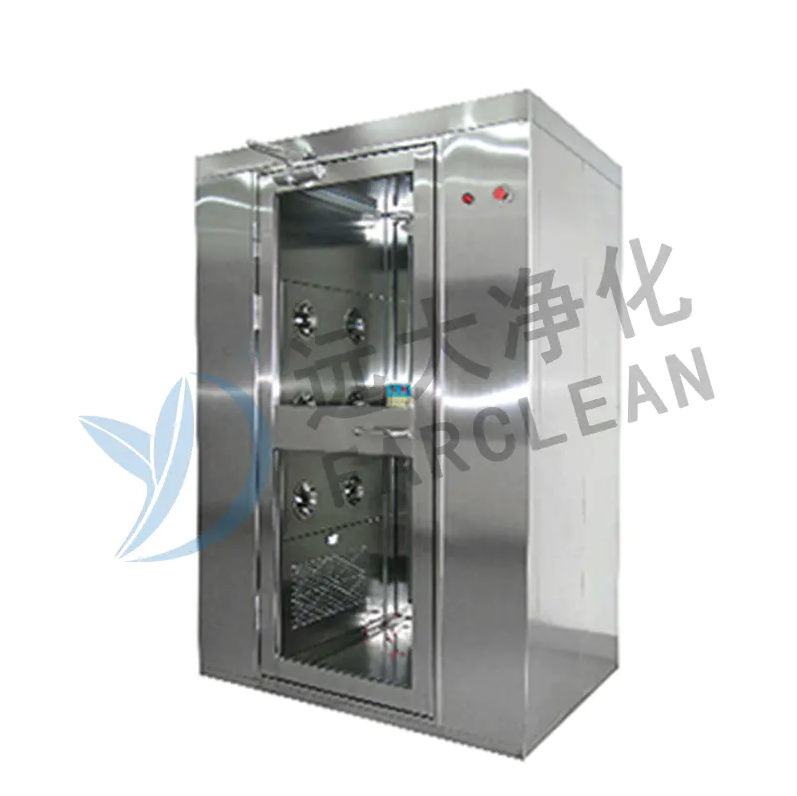
An all stainless-steel air shower room is a self-contained decontamination chamber installed at the entrance to cleanrooms, controlled environments, and precision manufacturing areas. Personnel or goods pass through the chamber, where high-velocity jets of HEPA-filtered air blast away surface particles — dust, lint, hair, and other contaminants — before entry is permitted. The defining characteristic of this category of air shower is that every structural surface, including walls, ceiling, floor plate, door frames, and nozzle housings, is fabricated from stainless steel rather than painted cold-rolled steel or composite panels. This material choice is not merely cosmetic; it fundamentally determines the unit's durability, hygienic performance, chemical resistance, and long-term cost of ownership.
The most common grade specified is SUS304 stainless steel, with SUS316L selected for pharmaceutical and biotechnology environments where exposure to aggressive cleaning agents or sterilization chemicals is routine. The smooth, non-porous surface of stainless steel resists bacterial adhesion, does not corrode under repeated disinfection, and does not shed particles of its own — a critical requirement when the surrounding cleanroom may be rated ISO Class 5 or cleaner.
Why Material Choice Directly Affects Cleaning Performance
Many facility managers underestimate how much the construction material of an air shower influences whether contamination control goals are actually met in practice. A painted steel air shower may deliver the same initial airflow specifications as a stainless-steel unit, but over time the painted surface chips, corrodes, and itself becomes a particle source. Epoxy or powder-coat finishes degrade under UV exposure and repeated chemical wiping, creating microscopic surface irregularities that trap contaminants between cleaning cycles. In contrast, stainless steel maintains its surface integrity indefinitely under normal cleanroom disinfection protocols.
The interior geometry also matters. All stainless-steel air showers are typically manufactured with fully coved corners — curved junctions between walls, floor, and ceiling — rather than sharp 90-degree angles. Coved corners eliminate the particle-trapping dead zones that exist in square-corner construction, making each wipe-down faster and more thorough. This design feature, common in pharmaceutical-grade stainless enclosures, directly supports achieving and maintaining the particle count targets defined in your contamination control plan.
Core Components and How They Work Together
Understanding the functional architecture of an all stainless-steel air shower helps facilities engineers specify the right unit and operators use it correctly. The key subsystems are:
- HEPA or ULPA Filtration: High-Efficiency Particulate Air filters capture 99.97% of particles ≥0.3 µm; Ultra-Low Penetration Air filters achieve 99.9995% efficiency at 0.12 µm. The filter housing is typically recessed into the stainless ceiling plenum to maintain a flush, cleanable interior surface.
- Stainless Steel Nozzle Arrays: Adjustable 304 stainless nozzles are positioned on opposing side walls and, in some designs, the ceiling. They direct high-velocity air jets (typically 20–25 m/s) at the person or goods from multiple angles simultaneously, dislodging particles that standard laminar airflow alone cannot remove.
- Interlocked Stainless Doors: Electronic interlock systems prevent both doors from opening simultaneously, maintaining the pressure differential between the dirty corridor and the cleanroom. Door frames and seals are integrated into the stainless structure without exposed fasteners that could harbor debris.
- Recirculating Blower System: A centrifugal fan draws room air, passes it through the HEPA filter, and recirculates it through the nozzles. Energy-efficient EC (electronically commutated) motors are increasingly standard, reducing operating costs in facilities running air showers 24 hours a day.
- Control Panel and Timer: A PLC or microprocessor controller manages blow time (typically 15–30 seconds), door interlock logic, alarm outputs, and — in advanced models — data logging for GMP audit trails. The control panel fascia is flush-mounted in stainless to maintain the cleanable surface envelope.
Matching Air Shower Specifications to Your Cleaning Goals
No single air shower specification suits every application. The right unit is determined by your cleanroom classification, the nature of the contamination risk, throughput requirements, and the type of items entering the controlled zone. The following table outlines how key parameters should be matched to common facility scenarios:
| Facility Type | Recommended ISO Class | Filter Type | Blow Time | Steel Grade |
| Electronics / Semiconductor | ISO 5–6 | ULPA H15 | 25–30 sec | SUS304 |
| Pharmaceutical / Biotech | ISO 5–7 | HEPA H14 | 20–30 sec | SUS316L |
| Food Processing | ISO 7–8 | HEPA H13 | 15–20 sec | SUS304 |
| Medical Device Manufacturing | ISO 6–7 | HEPA H14 | 20–25 sec | SUS304 / 316L |
| Precision Optics | ISO 5 | ULPA H15 | 30 sec | SUS304 |
Personnel vs. Cargo Air Showers: Different Configurations for Different Goals
All stainless-steel air showers are available in personnel and cargo variants, and selecting the correct type is essential to achieving your specific decontamination objectives. Personnel air showers are typically single-person or multi-person tunnel designs with standard door heights of 2.0–2.2 meters. The nozzle layout is optimized to cover the human body profile, including the head, shoulders, torso, and legs, using rotating or fixed jets positioned to avoid particle re-deposition.
Cargo or goods-pass-through air showers, by contrast, feature wider and taller openings to accommodate trolleys, pallet jacks, and large equipment. The stainless steel floor plate must be rated for the expected load — pharmaceutical facilities often specify 500–2000 kg/m² capacity — and the nozzle geometry is adjusted to address flat horizontal surfaces such as cart tops and container lids, where particles tend to settle and resist dislodgement by side-only jets. Some facilities install combination units with adjustable nozzle banks that can serve both personnel and small goods, improving throughput flexibility without duplicating entry points.
Operational Best Practices to Maximize Decontamination Effectiveness
Even the highest-specification all stainless-steel air shower will fail to meet cleaning targets if it is operated incorrectly. Training personnel on proper use protocols is as important as the hardware specification itself. The following practices should be incorporated into your standard operating procedures:
- Slow rotation during blow cycle: Personnel should turn slowly — approximately one full rotation over the blow cycle — to expose all body surfaces to the air jets. Standing still reduces decontamination efficiency by 30–50% compared to slow rotation.
- Arms raised: Raising arms away from the body exposes the torso, underarm, and sleeve areas that are otherwise shielded. This single action meaningfully improves particle removal from gowning suits.
- No re-entry without full cycle: Enforce the interlock so that personnel who exit back into the dirty corridor must complete a full new cycle before re-entering. Many contamination incidents trace back to partial or bypassed cycle completion.
- Regular filter integrity testing: HEPA/ULPA filters should be tested using DOP (dioctyl phthalate) or PAO (poly-alpha-olefin) aerosol challenge per ISO 14644-3 at commissioning and annually thereafter. A compromised filter delivers zero protection regardless of how well the stainless enclosure performs.
- Interior cleaning schedule: Wipe down all interior stainless surfaces with IPA (isopropyl alcohol) or facility-approved disinfectant at defined intervals. The non-porous stainless surface supports this protocol without degradation, but a written schedule prevents the chamber itself from becoming a contamination source.
Integration with Broader Contamination Control Strategy
An all stainless-steel air shower room is most effective when it is integrated into a layered contamination control strategy rather than treated as a standalone solution. In a well-designed cleanroom entry system, the air shower functions as the final active decontamination step after gowning, and is positioned between the gowning anteroom and the cleanroom itself. The pressure cascade — from lower pressure in the corridor to higher pressure in the cleanroom — must be maintained through proper door interlocking to prevent cross-contamination during transitions.
Facilities targeting GMP Grade A/B or ISO Class 5 environments should also consider combining the air shower with tacky mats at both entries, UV germicidal lamp cycles between shifts, and particle counter monitoring at the cleanroom entry point. Data from inline particle counters can be linked to the air shower's PLC to trigger extended blow cycles or alarms when ambient particle counts exceed action limits, creating a responsive rather than fixed decontamination protocol.
Total Cost of Ownership and Long-Term Value
All stainless-steel air showers carry a higher initial acquisition cost than painted or galvanized alternatives — typically 20–40% more depending on size and configuration. However, the total cost of ownership calculation over a 10–15 year facility lifecycle consistently favors the stainless option. Painted units require repainting or relining every 3–5 years, generate downtime during refurbishment, and may require decommissioning if the substrate beneath the paint begins to corrode and shed particles into the controlled environment. Stainless steel requires no such intervention; a properly maintained unit retains its original surface integrity and contamination control performance indefinitely.
Energy consumption is the dominant ongoing cost in air shower operation. Specifying EC motor blowers over traditional AC induction motors can reduce electrical draw by 25–40% at equivalent airflow, with payback periods under three years in facilities operating air showers continuously. When combined with demand-controlled ventilation logic — reducing blower speed between cycles — the stainless-steel air shower becomes not only the most hygienic but also the most energy-efficient entry decontamination solution available for demanding cleanroom environments.